by Ethan Walker
There is a version of weight loss that leaves you lighter but weaker, softer and more tired than when you started.
Most men over 40 who “just eat less” end up there. The scale goes down, the trousers fit, and yet the body looks and feels worse. The reason is simple: when you lose weight without protecting your muscle, a big chunk of what comes off is muscle.
This matters more after 40 than it did at 25, because you are already losing muscle in the background. From roughly your mid-thirties onwards, muscle mass declines with age, and the rate picks up in later decades [1]. Dieting carelessly on top of that is like running a tap while the bath is already draining.
The good news is that the fix is not complicated. It comes down to four things, and none of them require a gym membership you will cancel by March.
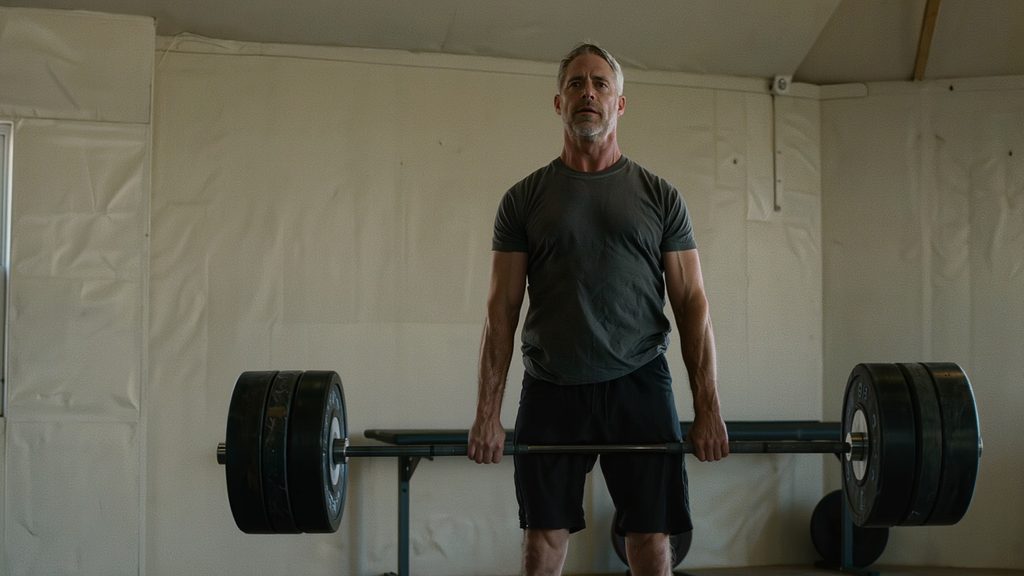
Image: Resistance training is what tells the body to keep muscle while calories are short.
The problem: dieting alone eats muscle
A review of 52 weight-loss studies in middle-aged and older adults found that when people lost weight through diet alone, 81 percent of the groups lost at least 15 percent of that weight as lean tissue rather than fat. When exercise was added to the diet, that figure dropped to 39 percent [2]. Same calorie deficit, very different result, purely because of what the body was asked to do while it was in deficit.
In a landmark trial in dieting obese older adults, the group that did resistance training alongside their diet held on to almost all their lean mass, while the diet-plus-aerobic group lost a meaningful amount of it. The combination of resistance and aerobic exercise gave the best result of all: the same fat loss with muscle preserved and physical function improved [3].
Why does this happen? Muscle is expensive tissue to maintain. When calories are short and nothing is asking the muscle to do work, the body treats it as surplus and breaks it down for energy. Lifting something heavy sends the opposite signal: this tissue is in use, keep it.
Fix 1: lift, twice a week, and do not overthink it
You do not need a bodybuilding programme. You need to load the big muscles two or three times a week and make it slightly harder over time.
A workable starting point is four movements: a squat or leg press, a hinge such as a deadlift or hip thrust, a push such as a press-up or bench press, and a pull such as a row. Two or three sets of each, in a range of roughly 6 to 12 repetitions, finishing each set with two or three reps still in the tank. That is a 35 to 45 minute session. Add a little weight or a rep or two when the current load feels comfortable.
The evidence does not favour any particular exercise selection. It favours doing resistance work at all, consistently, while dieting. If the only realistic option is dumbbells in the garage, that counts.
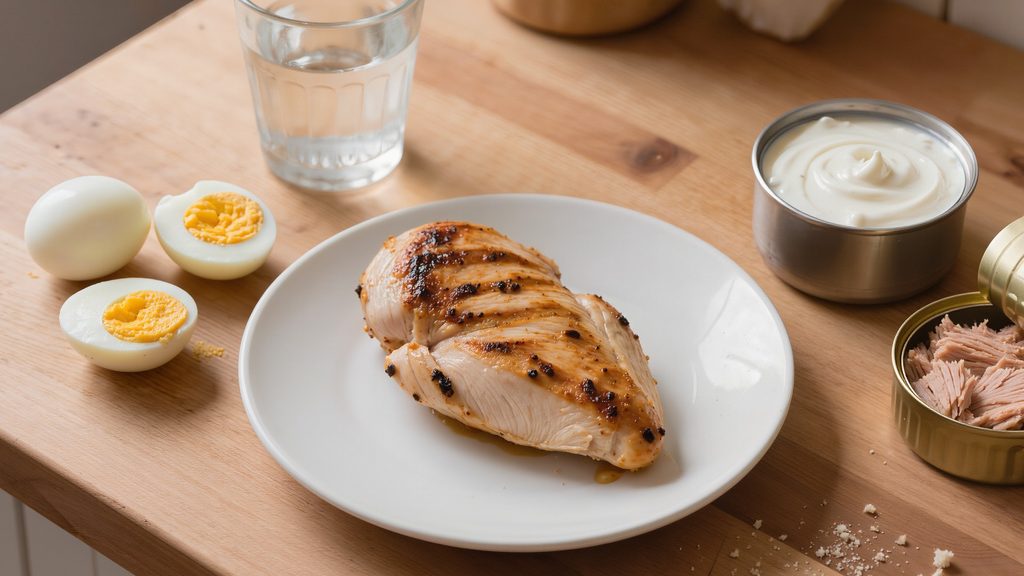
Image: A chicken breast, a tin of tuna, a pot of Greek yoghurt and two eggs get you most of the way to 150g of protein.
Fix 2: eat more protein than you think you need
Protein does two jobs during a diet. It gives the muscle raw material to repair itself after training, and it is the most filling macronutrient per calorie, which makes the deficit easier to hold.
The clearest demonstration comes from a study in which young men on a hard calorie deficit combined with intense training were given either 1.2 or 2.4 grams of protein per kilogram of bodyweight per day. The higher-protein group lost more fat and actually gained lean mass while dieting. The lower-protein group lost fat but held lean mass flat at best [4]. That is a young, highly active group, but the direction of the effect holds across ages.
For a man over 40 who is training and cutting calories, a practical target is 1.6 to 2.2 grams per kilogram of bodyweight per day. For a 95 kg man, that is around 150 to 210 grams. It sounds like a lot until you break it down: a chicken breast, a tin of tuna, a pot of Greek yoghurt and two eggs get you most of the way.
Spreading it across three or four meals of 0.4 grams per kilogram or more each appears to make better use of it than one large protein meal at night [5]. If you want the number worked out for your bodyweight, we keep a set of free calculators at musclescience.org that does exactly this.
Fix 3: lose it slower than you want to
The temptation at 40-plus is to make up for lost time with an aggressive deficit. The research argues against it.
Elite athletes were assigned to lose roughly the same amount of bodyweight at two different rates: about 0.7 percent of bodyweight per week, or about 1.4 percent. The slower group gained lean mass and improved strength during the diet. The faster group lost lean mass [6]. The total weight change was similar. The composition of that change was not.
For most men, that translates to 0.5 to 0.8 kilograms per week. It feels slow. It is also the rate at which what you lose is mostly fat. A 500 to 600 calorie daily deficit will get you there without leaving you too flat to train.

Image: Same diet, same weight loss: the short-sleep group lost muscle instead of fat.
Fix 4: sleep like it is part of the programme
This is the one nobody wants to hear, because it is the hardest to change. In a controlled study, adults followed the same calorie-restricted diet under two conditions: 8.5 hours in bed per night, or 5.5 hours. Total weight loss was similar. But the short-sleep group lost 55 percent less fat and 60 percent more lean mass than the full-sleep group [7]. Same diet, same weight loss, and the tired group lost muscle instead of fat.
Sleep affects hunger hormones, training quality and recovery all at once. If you are choosing between a 5am training session on six hours of sleep and a lunchtime session on seven and a half, take the second.
What this looks like in a week
Three resistance sessions of 40 minutes. Protein at every meal, aiming for around 1.8 grams per kilogram across the day. A moderate deficit that produces 0.5 to 0.8 kilograms of loss per week. Seven or more hours of sleep on most nights. Walking, football or whatever you enjoy on top, because aerobic work helps fat loss and health without costing muscle, provided the lifting is in place.
Do that for twelve weeks and the scale will move less dramatically than a crash diet would move it. But the man in the mirror at the end will be leaner, stronger and better set up for the decade ahead, which is the whole point of doing this after 40.
About the author
Ethan Walker is the Training and Nutrition Editor at Muscle Science, an evidence-based site covering training, nutrition and health for people who lift. He writes practical guides on building and keeping muscle, backed by primary research.
References
- 1. Volpi E, Nazemi R, Fujita S. Muscle tissue changes with aging. Curr Opin Clin Nutr Metab Care. 2004;7(4):405-410. https://pubmed.ncbi.nlm.nih.gov/15192443/
- 2. Weinheimer EM, Sands LP, Campbell WW. A systematic review of the separate and combined effects of energy restriction and exercise on fat-free mass in middle-aged and older adults. Nutr Rev. 2010;68(7):375-388. https://pubmed.ncbi.nlm.nih.gov/20591106/
- 3. Villareal DT, Aguirre L, Gurney AB, et al. Aerobic or resistance exercise, or both, in dieting obese older adults. N Engl J Med. 2017;376(20):1943-1955. https://pubmed.ncbi.nlm.nih.gov/28514618/
- 4. Longland TM, Oikawa SY, Mitchell CJ, Devries MC, Phillips SM. Higher compared with lower dietary protein during an energy deficit combined with intense exercise promotes greater lean mass gain and fat mass loss: a randomized trial. Am J Clin Nutr. 2016;103(3):738-746. https://pubmed.ncbi.nlm.nih.gov/26817506/
- 5. Schoenfeld BJ, Aragon AA. How much protein can the body use in a single meal for muscle-building? Implications for daily protein distribution. J Int Soc Sports Nutr. 2018;15:10. https://pubmed.ncbi.nlm.nih.gov/29497353/
- 6. Garthe I, Raastad T, Refsnes PE, Koivisto A, Sundgot-Borgen J. Effect of two different weight-loss rates on body composition and strength and power-related performance in elite athletes. Int J Sport Nutr Exerc Metab. 2011;21(2):97-104. https://pubmed.ncbi.nlm.nih.gov/21558571/
- 7. Nedeltcheva AV, Kilkus JM, Imperial J, Schoeller DA, Penev PD. Insufficient sleep undermines dietary efforts to reduce adiposity. Ann Intern Med. 2010;153(7):435-441. https://pubmed.ncbi.nlm.nih.gov/20921542/